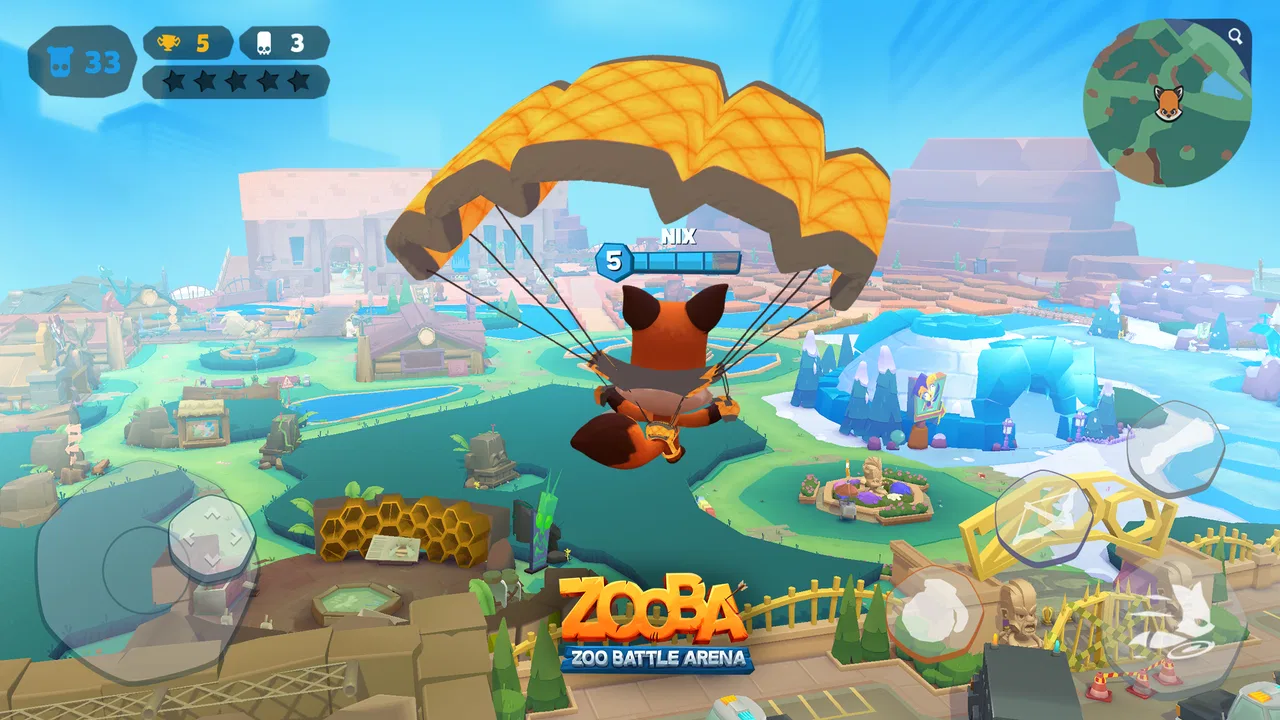
Zooba: Fun Battle Royale Games
- 4.6
- Rating
- 100.00M
- Installs
- Free
- Price

 Analysis by App-foxy
I approached Zooba: Fun Battle Royale Games as the kind of mobile action game you open when you want a quick contest rather than a long campaign. It comes from Wildlife Studios, is free to start, and combines shooting, character abilities, movement, and survival in a bright animal-themed setting. That combination makes it immediately approachable, but it also creates an important choice: are you looking for a fast, competitive game with a playful surface, or would a more traditional shooter, a slower strategy game, or a completely offline experience suit you better?
After spending time with it, my view is fairly clear. This is a strong choice for players who enjoy short multiplayer battles and like learning a roster of distinct characters. It is less convincing for anyone who dislikes repeated matches, online competition, touch controls, or the pressure to keep improving against other players. The game is easy to understand in a few minutes, yet its better decisions only become visible after several rounds.
What to consider before choosing Zooba
The first decision is about the type of action you want. This is not a conventional military shooter built around realistic weapons and serious presentation. Its animals, colorful arenas, and lively tone make the experience friendlier than many battle-focused games, while the central contest still asks you to aim, move, survive, and react quickly. I found that contrast useful: the game feels inviting when I start, but it does not become mindless once the match begins.
You May Also Like

 Blood Strike: 2.5 Anniversary
Blood Strike’s Loadouts Turn Every Drop Into a Tactical Gamble
A close look at Blood Strike’s custom loadouts: how fast access to signature weapons reshapes its battle royale rhythm, rewards preparation, and narrows the gap between fights.

 Pandora - Music & Podcasts
Pandora’s Music Is Easy to Start, but Harder to Recover
Pandora’s strength is its low-effort path from a seed to a station. Its weak spot is how much confidence it asks you to place in connection, setup, and quiet recovery.

 8 Ball Pool
 Is Built on Rivalries, Rematches, and Routine
A close look at the rivalries, rematches, shared routines, and unanswered safety questions that turn a quick pool match into a persistent mobile community.

 Samsung Music
’s Quiet Strength Is Playing What You Already Own
Its reach comes less from spectacle than from dependable access to a personal library. That simplicity is both the app’s strongest retention engine and its ceiling.

 AccuWeather: Weather Radar
AccuWeather Review: A Quick, Clear Forecast for Everyday Decisions
For everyday plans, the best forecast is the one you can understand quickly. AccuWeather makes rain timing, radar, and local conditions easy to act on, with a few trade-offs.

 Hill Climb Racing
Why Hill Climb Racing Still Turns Crashes Into One More Run
A tiny car, a bumpy hill and one more upgrade: Hill Climb Racing keeps resurfacing because its simple chaos makes every near-miss feel personal.
More From Our News Desk



The second question is whether you enjoy a match structure that repeatedly puts you into a compact survival challenge. You are not progressing through a linear story with a fixed sequence of missions. Instead, the appeal comes from entering another battle, making better choices than the previous time, and gradually becoming more comfortable with the available characters and situations. That loop is excellent for short sessions, but it can feel repetitive if you need constant changes of setting or a strong narrative reason to continue.
Touch control is another major part of the decision. On a phone, movement and aiming compete for space, so the early matches require some adjustment. I recommend spending time learning how the controls feel before judging the game too harshly. The first impression can be slightly awkward simply because your thumbs are doing several jobs at once. Once the layout becomes familiar, the controls support quick movement and sudden escapes, but they still demand more attention than a relaxed puzzle game.
The game is listed for players aged Everyone 10+, which matches its cartoon presentation and accessible tone. That does not mean every child will find it suitable in practice. Multiplayer competition can be exciting, but it can also become frustrating when a player loses several rounds in succession or feels pressure to improve. I would treat the age guidance as a starting point and consider the individual player's patience with competitive games.
Its broad reach is easy to understand. Zooba has passed over 100 million installs and holds a 4.6 average rating from roughly 1.6 million ratings. Those figures suggest that the basic formula works for a large audience, although popularity should not replace personal judgment. A game can be widely enjoyed and still be a poor fit for someone who wants offline play, a slower pace, or a one-time purchase.
The first matches: simple entry, meaningful adjustment
I like that the basic idea is easy to grasp without a long explanation. You enter a battle, move through the environment, use attacks and abilities, and try to remain effective while other players create threats around you. That clarity matters on a phone because it lets you begin playing quickly instead of reading through a large amount of background information.
The deeper learning comes from understanding space. A player who only focuses on attacking can walk into a poor position, expose themselves to several opponents, or waste an escape opportunity too early. I found that cautious movement often mattered as much as accurate shooting. Watching where pressure is developing, keeping a route open, and resisting the urge to chase every opponent can turn an ordinary round into a much better one.
One useful habit is to treat the opening moments as information-gathering time. Rather than immediately looking for a fight, I pay attention to nearby movement, available routes, and the kind of engagement that seems likely. This does not make every match safe, but it reduces unnecessary mistakes. It is one of those small changes that a store description cannot explain and that becomes valuable after the novelty wears off.
Another practical tip is to learn one character well before constantly switching between the roster. Trying everything is fun, but changing character after every disappointing result can make it difficult to understand whether the problem is the character, the situation, or my own decision. I prefer to use a familiar choice to learn positioning first, then experiment when I have a clearer sense of what I need from a different play style.
Why the character system gives the action its identity
The animal cast is more than a visual theme. Different characters encourage different approaches, and that gives the matches a layer of choice beyond simply aiming at whoever appears first. Some situations reward patience, others reward mobility, and some make it more important to control distance or choose the moment of engagement carefully. I enjoyed this because it made the game feel less like a single weapon test and more like a question of matching a style to a situation.
I would not recommend choosing a character only because it looks appealing. A character that feels exciting in a short trial may not suit the way you naturally play. If you tend to rush, a choice that encourages restraint can expose a weakness in your habits. If you prefer to stay at a distance, a more aggressive option may feel uncomfortable until you learn how to create space. The best choice is usually the one that helps you make sensible decisions consistently, not the one with the most impressive first impression.
A useful personal test is to ask what went wrong after a loss. If I repeatedly lose because I enter fights without an exit, I need to improve my positioning rather than immediately blaming the character. If I survive but cannot pressure opponents, then I may need a character or approach that better matches my confidence. This way of reviewing a match makes progression feel more deliberate and prevents the roster from becoming a source of random switching.
The character variety also helps when playing with friends. Even without turning every session into a serious team exercise, different approaches can make cooperation more interesting. One person may be comfortable creating pressure while another watches routes or supports a safer plan. I would not expect perfect coordination from casual groups, but the game gives friends enough room to discuss choices instead of simply rushing into identical fights.
Where Zooba is strongest in everyday play
Its biggest strength is convenience. If I have a short break between tasks, I can use that time for a few rounds without committing to a long campaign. That makes it a natural fit for a commute, a waiting room, or a brief evening session. The important caveat is that “short session” does not always mean “emotionally light session.” A close loss can make me want one more attempt, so the game can stretch a small break if I am not careful.
For example, I might open it after dinner with the intention of playing briefly before doing something else. The first round helps me warm up, the second feels more competitive, and a poor decision near the end creates the temptation to immediately correct it. I recommend deciding in advance how many rounds you want to play. That simple boundary keeps the game useful as a quick activity instead of letting the repeat-match loop take over the evening.
The action also has a good balance between accessibility and room for improvement. Someone new can understand the goal quickly, while a more experienced player can focus on timing, routes, and character choices. I appreciate games that do not require a long tutorial before becoming enjoyable, but still reward attention after the first hour. Zooba generally achieves that balance through its combination of movement, combat, and survival decisions.
Its presentation makes it easier to recommend to players who avoid grim or realistic shooters. The animal theme softens the atmosphere without removing competition. I can play it around family members without the visual tone feeling overly harsh, although the competitive pressure remains real. That distinction is worth remembering: a friendly art style does not turn the game into a purely casual experience.
Small decisions that improve the experience
One of my most useful adjustments was to stop treating every visible opponent as an immediate target. In a survival-focused match, an engagement can attract attention from somewhere else, consume an important ability, or leave me poorly positioned for the next encounter. Sometimes the better decision is to move, observe, and wait for another player to create the opening.
I also find it helpful to separate “winning the fight” from “winning the situation.” Eliminating an opponent may feel like success, but if I end the exchange exposed, weakened, or trapped between new threats, the result can still be bad. Thinking one step beyond the current target improves decision-making. This is especially important for players coming from arcade shooters where constant aggression is usually rewarded.
A third insight concerns practice. Repeating the same broad mistake does not automatically create improvement. After a round, I try to identify one specific issue: entering without an escape, chasing too far, using an ability too early, or failing to notice another route. Focusing on one correction makes the next match more useful than simply playing faster. It also reduces the feeling that progress depends only on luck.
Players who enjoy experimenting should keep notes mentally rather than trying to master everything at once. I might spend one session testing how a character handles close pressure, then another session concentrating on movement and survival. This creates a clearer learning path and makes the roster feel like a set of tools rather than a collection of cosmetic choices.
The real trade-offs: repetition, competition, and spending
Because the game is free, the initial barrier is low. I can install it, test the controls, and decide whether the match loop suits me without paying upfront. The financial question comes later. In-app purchases range from $0.99 to $394.99 per item, so I would approach the shop carefully and set a personal spending limit before making any purchase. The presence of a free entry point does not automatically make the overall experience inexpensive for every player.
This is particularly important for families. If a child is playing on a shared device, I would discuss purchases clearly and make sure the account holder understands what can happen before allowing regular play. Even when a player intends to spend nothing, the game can create a strong “one more round” feeling, and that same momentum can influence decisions around optional items. A clear rule is more useful than relying on willpower during an exciting session.
The other trade-off is time. The game works well in short bursts, but the competitive loop encourages repetition. Players who enjoy chasing better performance will see that as a benefit. Players who want a game that ends naturally after a single self-contained activity may find the structure less satisfying. I would skip it if I know I am trying to reduce competitive screen time or if repeated losses tend to spoil my mood.
Online competition also means that the quality of a session can vary. My experience depends not only on my own decisions but on the behavior and ability of other players. That uncertainty is part of the appeal, yet it can be frustrating when I want a predictable challenge. Someone looking for a carefully paced solo adventure would probably be happier with a narrative action game or a title designed around offline progression.
How it compares with other mobile action choices
Compared with a traditional shooter, Zooba feels less focused on realism and more focused on character identity and survival decisions. A conventional shooter may be better if you want familiar weapon handling, a serious atmosphere, or a direct team-versus-team structure. Zooba is the better fit when you want a lighter presentation and enjoy adapting to different character approaches.
Compared with a strategy game, it asks for faster physical reactions. Planning still matters, but you cannot pause to consider every possibility. Movement, aiming, and timing happen together. I would choose a strategy alternative when I want deliberate planning and a calmer pace; I would choose Zooba when I want decisions to feel immediate and hands-on.
Compared with a solo action adventure, it offers less control over the rhythm of the experience. You are not following a carefully authored path where each encounter has a designed purpose. Instead, the appeal comes from unpredictable contests and the satisfaction of making better choices in a changing situation. That makes it more replayable for competitive players, but less rewarding for anyone who values story, exploration, or a definite ending.
Compared with a simple arcade game, it has more room for improvement and personal style. The cost is that it demands more attention. If you want something to play casually with almost no learning curve, another arcade option may be kinder. If you enjoy understanding why a round went well or badly, Zooba offers more to analyze.
Who should make the switch, and who should not
Switching to Zooba makes sense if your current mobile action game feels too serious, too slow, or too dependent on a single play style. The animal cast provides an approachable entry point, while the competitive structure gives experienced players reasons to keep refining their decisions. It is also a good candidate for friends who want to compare results and discuss character choices after a session.
The cost of switching is mostly learning rather than money. You need time to become comfortable with touch controls, understand how different characters change your options, and accept that survival often requires restraint. If you are coming from a game with very different controls, the first few rounds may feel less responsive than expected. I would give it enough time to learn the movement before deciding that the combat is not for you.
I would not switch if your priority is a complete offline experience, a one-time purchase with no further spending decisions, or a story that steadily carries you from one chapter to the next. I would also avoid it if losing against other players quickly makes games unpleasant. The bright presentation may look relaxed, but the underlying loop still asks you to compete, adapt, and accept setbacks.
The current version is 6.5.0, and the game supports Android 7.0 or later. That makes checking your device software a sensible step before installing. On compatible hardware, I would still consider how comfortable the screen is for touch aiming and movement. A smaller display can make the controls feel more crowded, while a larger one may make it easier to keep track of the action.
My recommendation after weighing the alternatives
I recommend Zooba to players who want a free mobile action game built around quick multiplayer survival matches, character variety, and a playful visual style. Wildlife Studios has created a game that is easy to enter but not entirely shallow. The best moments come from decisions that are easy to overlook at first: choosing when not to fight, preserving an escape route, reading the space around an opponent, and selecting a character that matches the situation rather than personal impulse.
I would recommend trying it with a simple plan: play enough rounds to learn the controls, settle on one character for a while, and judge your enjoyment by the decisions you make rather than by your result in a single match. If you find yourself thinking about positioning and timing between rounds, the game probably has the depth you want. If you only feel frustration or repetition, switching to a solo action game or a slower strategy alternative will likely be the better choice.
With more than 30 thousand reviews and a large established player base, it is clearly not an obscure experiment. Still, its popularity does not remove the need for boundaries around time and optional spending. I would keep purchases deliberate, set a session limit, and remember that a colorful game can still be competitive enough to demand concentration.
My final verdict is positive but specific: Zooba is best when you want accessible action with enough tactical detail to reward careful play. It is not the universal answer for mobile gaming, and it should not replace a story-driven or offline title if those are your priorities. For the right player, though, it turns short breaks into lively contests and gives each match enough uncertainty to make improvement feel earned.
FAQs for Zooba: Fun Battle Royale Games
01What is Zooba: Fun Battle Royale Games?
Zooba: Fun Battle Royale Games is a fast-paced multiplayer game where players compete in a zoo-themed arena. Each player chooses an animal character with unique abilities and battles against others to be the last one standing. The game combines elements of strategy, action, and survival, making it engaging for all ages.
02Is Zooba free to play?
Yes, Zooba is free to download and play, but it offers in-app purchases. These purchases can enhance gameplay by unlocking new characters, skins, and other features. While the game is enjoyable without spending money, some players opt to make purchases for a more personalized experience.
03What platforms is Zooba available on?
Zooba is available on both Android and iOS platforms. You can download it from the Google Play Store or Apple App Store. The game requires a stable internet connection to play, as it involves real-time multiplayer battles against players from around the world.
04Can I play Zooba with friends?
Yes, Zooba allows you to team up with friends in duo or squad mode. You can invite friends to join your team and strategize together to defeat opponents. Playing with friends can enhance the experience, making battles more coordinated and potentially increasing your chances of winning.
05What are some tips for beginners in Zooba?
For beginners, it's crucial to understand each character's abilities and strengths. Start by practicing with different characters to find the one that suits your playstyle. Stay aware of the shrinking play area and collect weapons and health items scattered around the map. Also, consider watching tutorials or gameplay videos for strategies and tips from experienced players.
Pros
- Engaging multiplayer battles
- Diverse character selection
- Frequent updates and events
- Smooth controls and gameplay
- Vibrant graphics and animations
Cons
- In-app purchases can be pricey
- Requires constant internet connection
- Occasional matchmaking delays
- Limited offline functionality
- Battery consumption is high

Zooba: Fun Battle Royale Games
Gallery